Greener pastures
Senior director of sustainability at HelloFresh Jeff Yorzyk ’92 wants to fix the food waste problem in America.
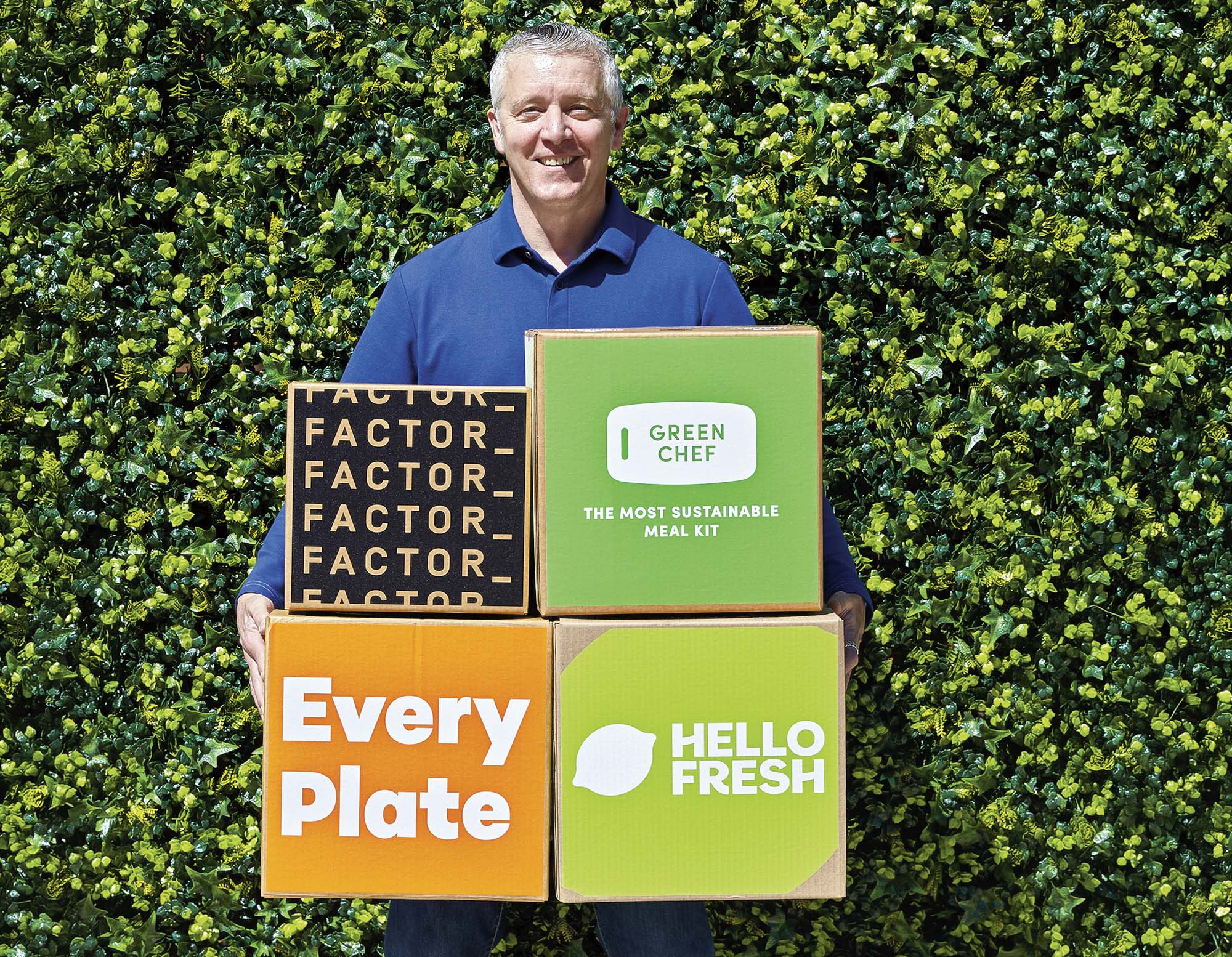
Subscription-based meal kits are as varied as the customer’s tastes and needs.
Photograph Courtesy of HelloFresh
Jeff Yorzyk grew up canoeing and camping on the Connecticut River in northern Massachusetts with his family, establishing from an early age an appreciation and comfortability with the outdoors.
When he enrolled at Lafayette in the late ’80s, environmental engineering wasn’t available at the College—or anywhere, for that matter—but there was an environmental interest group on campus. At one point, conservation activist Lou Gold was invited to speak about old growth forest loss. “He said environmentalism isn’t a spectator sport,” Yorzyk recalls. “And that was a call to action for me. It influenced my choice to focus my career on the environment and, eventually, sustainability.”
Yorzyk would earn a chemical engineering degree, arming him with an understanding of how industry affects the environment. A liberal arts setting programmed him to think about problems differently and ask broader questions, specifically in engineering and the environment.
While on a six-day hike in the Colorado mountains in 1999, Yorzyk wrote down a question in his journal that would serve as a compass throughout his career: What would it take to get in front of waste before it happens? After spending some time in the environmental field, he earned a master’s in environmental science and engineering, and an MBA, and was hired by a sustainability consulting firm in 2003. “I found my way to an emerging career space that didn’t exist when I graduated,” he says.
Over the years, his consultant expertise would support government agencies like the National Oceanic and Atmospheric Administration. Then, a decade ago, he came onto the meal kit scene in the U.S., and has been the senior director of sustainability at HelloFresh based in Boulder, Colo., since 2016.
Yorzyk, who was recently named chair of Lafayette’s Sustainability Alumni Affinity Network, weighs in on America’s food waste problem—and what to do about it.

Why is food waste in America such an issue?
Food waste is such a big issue because it’s happening at the same time as widespread food insecurity. Statistics show that 40% of the food supply is wasted, mainly because of distribution inefficiency. There are 48 million people facing food insecurity in the United States—with 14 million of them being children—yet we throw away more food than any other country. Food waste is the one-two punch of sustainability. We waste an environmental investment that’s made at the farm level to create the food, and then it goes to the landfill, creating methane and greenhouse gasses.
How are you trying to prevent food waste at HelloFresh?
My team is relentless on minimizing food waste from our operations. If food is edible, we donate it to local charities and food banks. At the end of 2025, 90% of HelloFresh’s food waste is diverted from landfill. If it’s not edible, then we’re trying to get it into composting or anaerobic digestion, which creates biogas. We reduced our food waste going to landfill by 78% in the last five years by partnering across the business.
How can meal kits help?
The impact of pre-portioning food and planning meals is really substantial. We did an in-home food waste study back in 2019 that demonstrated an approximate 45% reduction in food waste related to making dinner from our U.S. customers. We then did a product Life Cycle Assessment and showed that between the food waste and more efficient logistics—people aren’t driving back and forth to a grocery store, for example—we actually reduce the carbon footprint of a dinner meal by 31%.
Why is planning meals so valuable? It makes sure you avoid buying food you don’t need and you buy the appropriate portion size. Really think about produce and perishable items, and don’t overbuy in the first place. That source control, and not letting things go bad in the fridge, is inherent to the meal kit model.
What else can consumers do?
Understand that ‘best-by’ dates do not mean ‘bad after.’ These dates are really creating a lot more food waste than is appropriate. Depending on the product, there’s flexibility. We certainly have to exercise caution with perishable items, but we also have to exercise judgment. And then, finally, eat your leftovers. Food belongs in people, not in landfills.
Sustainability wasn’t a field when you graduated. What advice do you have for people interested in this space?
My career evolved in ways I couldn’t have predicted, and things I did previously became useful in ways I never would have expected. I created my career path by repeatedly asking myself how I could make a positive impact on the world—contributions that would outlast me. This field is so broad, it can be daunting, and there are a lot of entry points that aren’t obvious. The key is finding an intersection between what you’re passionate about and what you’re good at, and seeking to make a positive impact.