State of evolution
From 1985 until her retirement this year, biology professor Nancy McCreary Waters has been a pioneer for environmental programs.
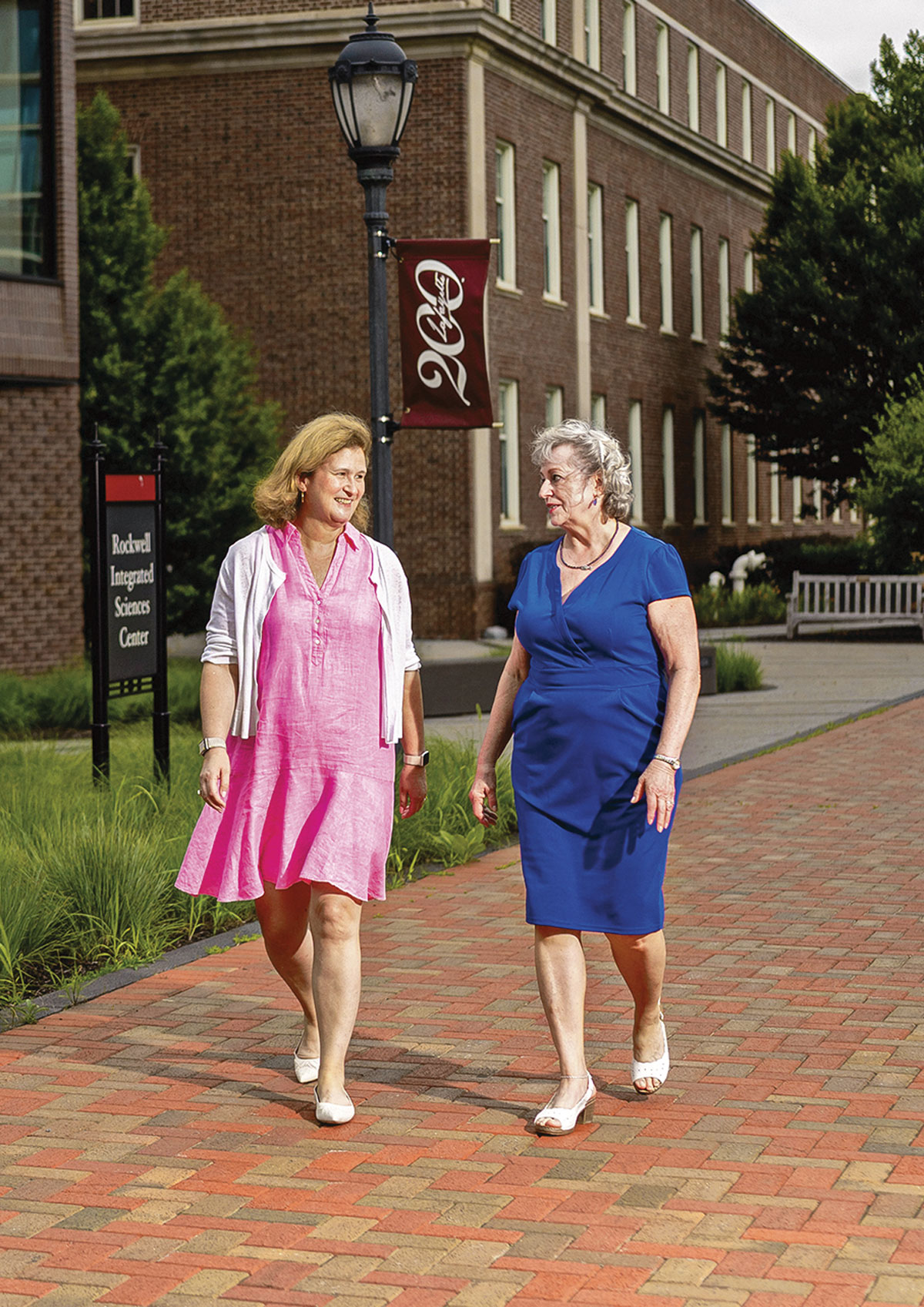
Photograph By Jaquan Alston; Illustration By Antonio Pinna
NH: After you arrived at Lafayette in 1985, you and your colleagues in the Biology Department built up learning opportunities for students.
NW: At the time, there was a single course: Organism and Environment. I updated it into our flagship ecology course. With other STEM colleagues, we began an environmental science minor.
NH: And now the College’s environmental studies program is a huge success. You created spaces for people.
NW: I’m really proud to have pushed for more laboratories, and then having them counted appropriately in our teaching load. There were some lab courses, but few, and none field-based. Labs bring other disciplines together.
NH: It’s a real joy that we’ve named our Health Professions Network in your honor. What excites you about retirement and staying connected to the College and alumni?
NW: Alumni have a deep love for Lafayette. We partnered beautifully with the Gateway Career Center to bring these alumni connections to life.
NH: You’re a teacher and scholar, but you also sing and act. How has your artistic side been fed on this campus?
NW: A liberal arts institution fosters lots of different parts of who we are. I have always thought that maybe I brought different skills to my science because of my art.
NH: As we go into our Third Century, it’s a powerful time to talk about alignment.
NW: That’s the wonderful thing about the future of Lafayette: We aren’t just a job or school. We’re a community. I want students to think about that when they’re considering medical school, graduate school, law school, or wherever it is they land.
NH: Right. The College is an engine of opportunity and we need to make sure students unlock their potential.
NW: In HP Advising, we went from a ‘soft touch’ approach to more hands on. Why? Because with the turn of the century, students have needed more guidance to their own self-knowledge.
NH: You are described as a ‘true gem’ among faculty and a cherished friend to alumni.
NW: That is really flattering, but as a community, we carry a force greater than the sum of all the parts. There is a holistic way of valuing what each entity brings to the table.
NH: Thank you for enabling so many women, and thousands of students, to see themselves as leaders.
NW: Over the course of a 41-year career, I am grateful to contribute. The sacrifices made were truly worth it.
Get to Know Nancy Waters
Waters, the first woman in her family to attend college, studied biology at Saint Francis University and earned a Ph.D. in biology at University of Notre Dame. Recently retired, she received the Daniel L. Golden ’34 Faculty Service Award in June.
Expertise
Waters strongly contributed to shaping the Biology Department curriculum over the past four decades, including support for broader environmental programs, as well as neuroscience and other interdisciplinary programs.
Noteworthy
The College just launched the Professor Nancy McCreary Waters Health Professions Affinity Network in recognition of her longtime advising role.
Meaningful Moment
Waters is particularly proud of the David Nalven ’88 Fund because he was a part of her first National Science Foundation grant: “His friends and family established this fund in his memory, and it has now served more than 70 fellows with summer research opportunities.”
Last Word
“Our identities are not unilateral. For me, this is the thing that resonates with us as human beings: We are not monolithic.”