Modeling old Pardee
Jon Tsai’s tabletop version of a favorite campus building is work at play.
Photography By Jaquan Alston
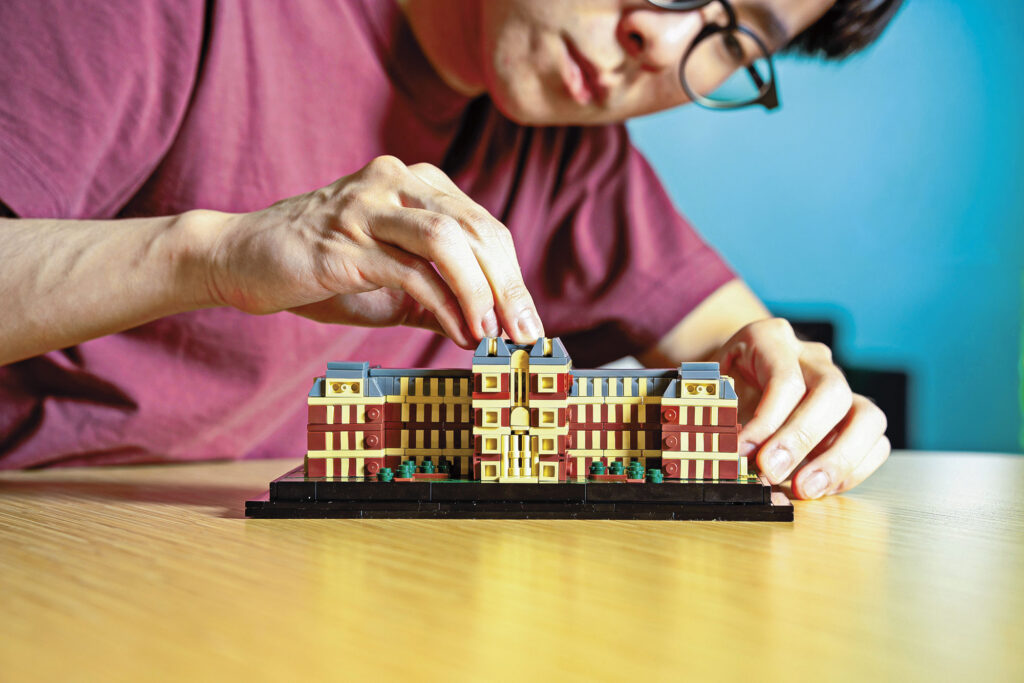
A childhood love of building Legos is at the foundation of what moved Jon Tsai ’28 to become a Lafayette-trained civil engineer. He recently applied those sophisticated design skills to create a detailed display model of one of the most recognizable academic buildings on campus.
Using 1,700 tiny interlocking plastic bricks that he sourced from boutique suppliers around the world, Tsai, a civil engineering major, has been working since fall 2024 on a tabletop “Pardee Hall” at the urging of his professor.
Details in his prototype are dizzying to behold from the moment he starts to delicately deconstruct the model, revealing dense layers of colorful pieces, some the size of peas. It’s a kaleidoscope of engineering design.
As Tsai pops off its steep mansard roof, Pardee Hall suddenly seems like a Russian nesting doll, with ever deepening tiers of foundations and support pieces on each interior floor. From the towering chimneys and roofline dormers, to the landscaping and pillar-lined main entrance below, every contour of the iconic Second Empire edifice is captured in the 400 briquettes on each of the three floors and attic.
In Tsai’s experience, engineering is always about finding the right balance between the most practical and effective designs. “One of the biggest lessons I’ve learned from designing models over the past four years is how to approach seemingly impossible problems one step at a time,” he says. “Creative problem-solving is essential when traditional methods reach their limits. But I have also learned there is still tremendous value in proven design techniques.”
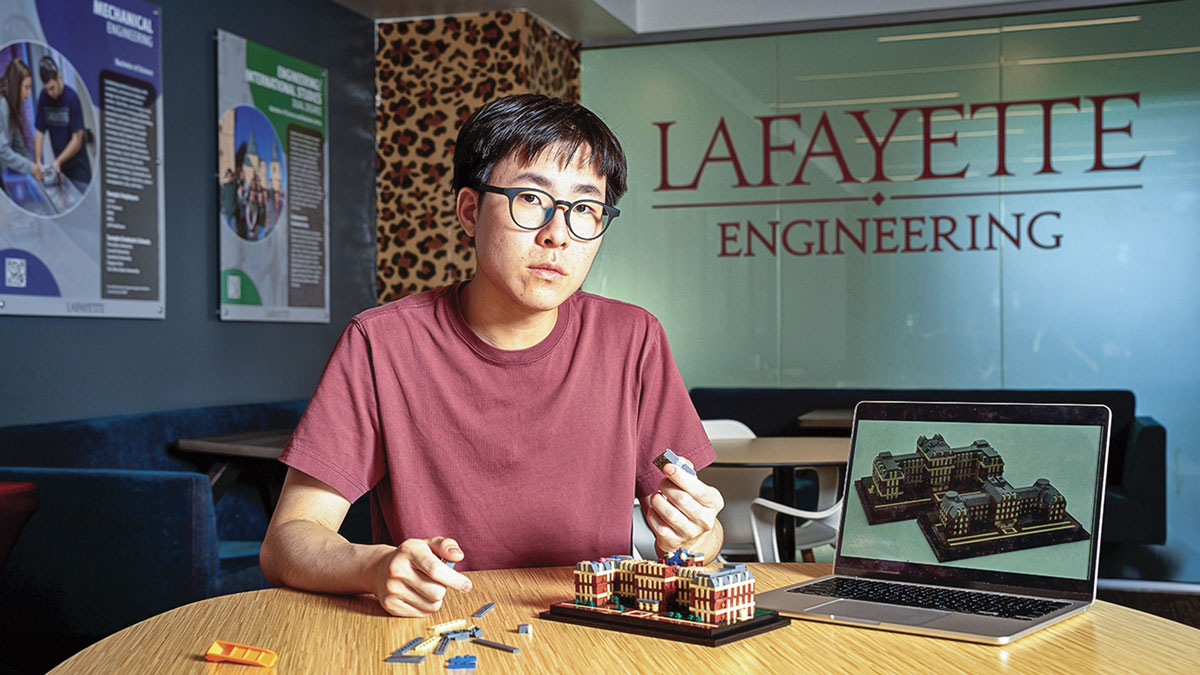
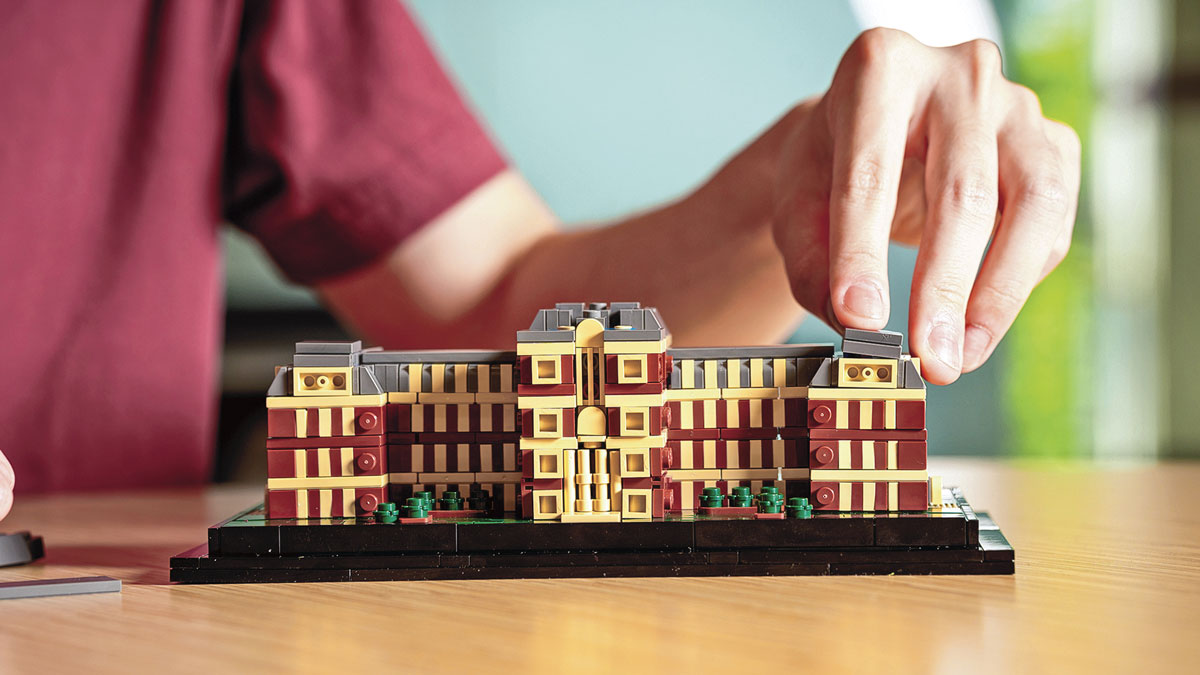
Tsai estimates that his model takes about six hours to assemble. “It’s complicated, but in a good way, like a Rubik’s Cube. It’s fun, simple, and complex all at once.”
Mike McGuire, professor of civil and environmental engineering and department head, got to know Tsai in his ES 101 course in fall 2024, which focused on trail design around campus.
“What caught my attention was the way Jon drew on his experience designing models with interlocking bricks and used 3D modeling software to help visualize the trail design,” he recalls. “That opened up a conversation. I was impressed not only by the technical skill involved, but also by his creativity, initiative, and entrepreneurial spirit.”
McGuire soon learned that Tsai’s other complex designs had reached an international audience. His Instagram account (@brick.naval.architecture) displays photos of his models of The Queen Mary, the Space Shuttle, and vintage battlecruisers. The French navy took notice of his work and commissioned Tsai to design a model of its icebreaker, L’Astrolabe. It’s now for sale in the onboard gift shop.
“This has always been a side hobby for me,” Tsai says. “Prof. McGuire just threw out a cool idea during one of our office hours visits and suggested pursuing something related to the upcoming Bicentennial. At the time, I wasn’t so confident, but I was gaining experience with my work on the French icebreaker and decided Pardee Hall would present a satisfying challenge.”
Campus builds
As Tsai puts the final touches on his Pardee Hall model, his imagination has turned to other landmarks on College Hill. Here, he ranks what design challenge could be next for him.
1.
Colton
Chapel
With iconic architecture, the chapel would translate very well into a physical model.
2.
South
College
The residence hall would be a popular build given its significance to many students.
3.
Markle
Hall
Markle boasts a beautiful façade and is one of the first places families encounter Lafayette College.
Tsai’s project has been much more than simply designing a model.
McGuire says this process has required engineering design judgment, product development, international business communication, solving problems related to supply chains, engagement with College stakeholders, and project management skills that connect directly to Tsai’s civil engineering coursework.
“It’s made out of so many little tiny components, and the reason for this is because you want to get the shape and color of the windows as accurate as possible,” Tsai says. “A major limitation of the model is that to get the number of details in such a small package, you need to use a lot of small components.”
For him, this project recreating Pardee has confirmed his chosen career path as a civil engineer.
“I thought it was going to be really easy because it’s just a building. You stack things from the bottom to the top,” he says, smiling. “But then it turns out you start running into scenarios where there’s many sorts of individually impossible tasks that have to happen simultaneously in this model.
“If you solve one problem, you actually make other problems more impossible, and you have to balance this. It’s very much one impossible task at a time,” he adds. “I appreciate more how engineers do this on an advanced scale, and how Lafayette Engineering prepares you for every possibility, from design to implementation.”
“This project is a wonderful example of how hands-on creative endeavors at Lafayette can produce a broad range of positive impacts, some of which may be entirely unexpected,” McGuire says. “The talents and skills Jon has demonstrated, such as careful observation, spatial reasoning, iteration, patience, and attention to constructability, are the same habits that underlie strong engineering design. Everything about Jon’s project reflects the hallmarks of Lafayette’s civil engineering program.”