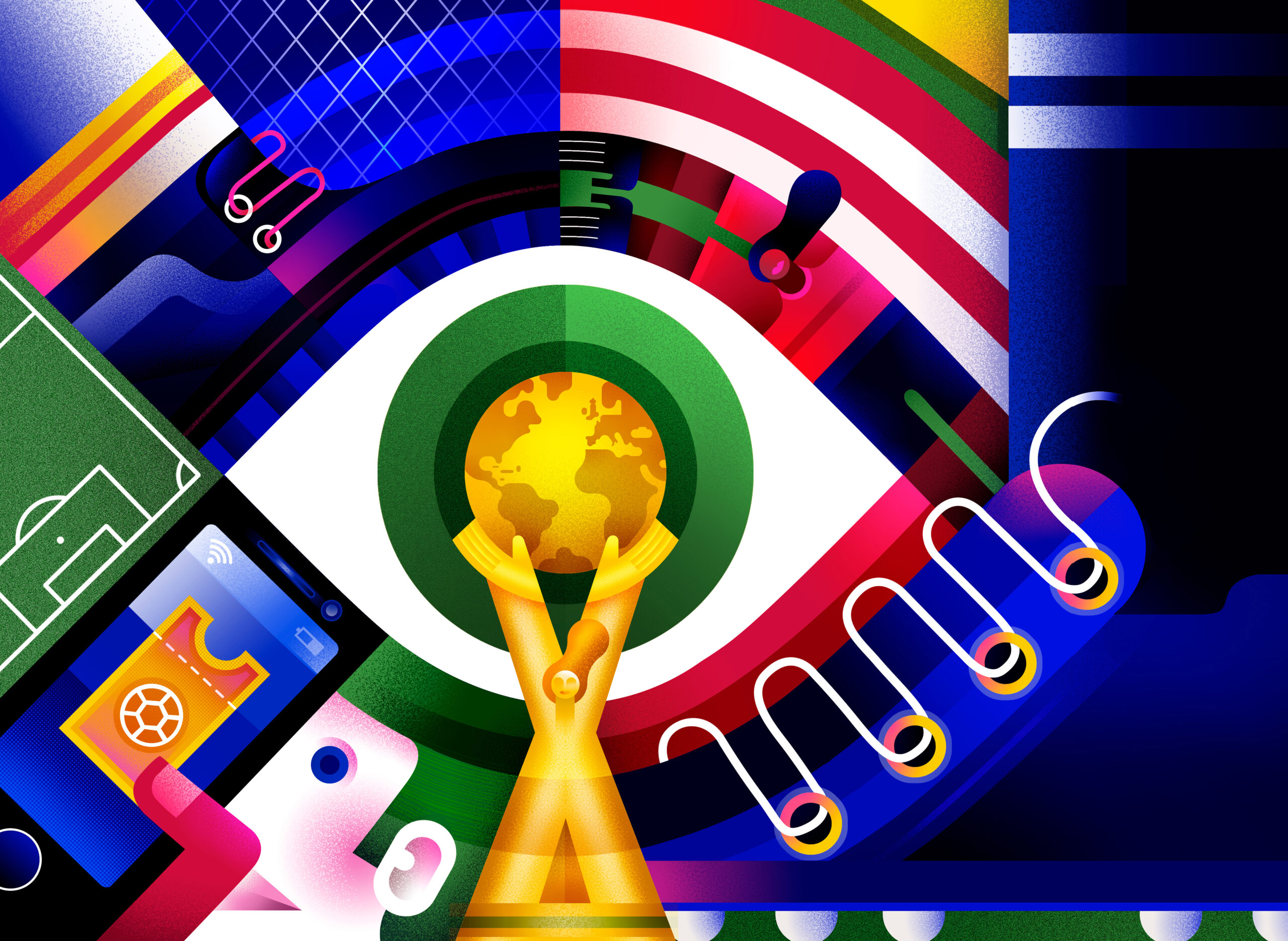
Illustrations by maríA corte
Fútbol Frenzy
With the World Cup taking over North American cities this summer, a very soccer-obsessed United States readies for its latest surge in the sport.
In the summer of 1989, World Cup hopes for the United States men’s soccer team were dimming. Lackluster performances against regional opponents Costa Rica and Trinidad and Tobago made for an uphill climb for the team to reach the prestigious tournament in Italy the following year.
But there was even more on the line than earning a prized ticket to the quadrennial soccer extravaganza: The United States had been selected as host for the 1994 World Cup despite not having qualified since 1950. It was a controversial decision, but the sport was showing green shoots in the U.S., and the infrastructure and commercial possibilities were appealing. As hosts, the U.S. had an automatic berth for 1994, but to justify the world’s faith—and as a point of pride—the U.S. team desperately wanted to make it to the 1990 tournament on their own power.
One thing the team needed more than anything was competitive friendly matches to sharpen their game. Richard Groff ’68 had a plan. “I was very fortunate that the president of U.S. Soccer at the time was from Pennsylvania and a friend of mine,” he says.
Groff, currently a commissioner in Adult Amateur Soccer, has held numerous positions in U.S. Soccer—the nation’s governing body for soccer—including treasurer. “I remember being in St. Louis at the time, and 6,000 people showed up for a game. I thought it was a disgrace. So, I suggested to the president, ‘Let’s do a match in Philadelphia.’ He said I didn’t know what I was doing, but I told him to trust me.”Groff invited Dnepr, a club team based in Ukraine that was reigning league champions of the U.S.S.R., to play the U.S. team on a Friday night in August 1989 at University of Pennsylvania’s Franklin Field in West Philadelphia.
With a little creative marketing—Groff billed the event as an “America vs. Russia smackdown”—his plan worked. Televised on TNT, it drew more than 43,000 fans, the most that had attended a soccer match in the U.S. since the Los Angeles Olympic Games in 1984. The U.S. beat Dnepr that night, 1-0, on a turf field that still had football lines visible.
The U.S. went on to qualify for the 1990 World Cup with a wonder goal by Paul Caligiuri in its final match, and made it to Italy. At home in 1994, the team exceeded expectations with a victory over a highly regarded Colombian squad and made it out of the group stage. Meanwhile, the U.S. women’s team had won the first women’s World Cup in 1991, the start of decades of dominance for them.
Soccer, it seemed, was on an inevitable rise to rival football, baseball, and basketball in the pantheon of our nation’s sport.
It’s been a longer haul than many anticipated, but with thriving men’s and women’s domestic leagues and the United States co-hosting this summer’s World Cup alongside Canada and Mexico, it could be soccer’s moment to hit new heights—and if it does, it will be in part a result of efforts by hardworking Lafayette alumni, some, like Groff, who have dedicated their careers to bringing soccer into the mainstream.
Soccer, football, or the “jogo bonito” (beautiful game) as Brazilians call it, is by a large margin the world’s foremost sport in terms of viewership. It is estimated that in 2022 the monthlong World Cup tournament garnered 5 billion viewers.
In the U.S., NBCUniversal—where Jose Garriga ’95 has been vice president of NBC Sports & Telemundo global sports sales for a decade—will be showing all Spanish-language broadcasts of the 2026 World Cup on Telemundo and other platforms. NBC also shows the wildly popular English Premier League matches to American audiences, and streaming giant Netflix has locked in the domestic broadcast rights for the next two women’s World Cups in 2027 and 2031.
In January, a headline in The Economist blared, “America is now the biggest market for international football.” The magazine cited a survey that landed soccer third on the list of self-declared favorite sports in the U.S., only behind American football and basketball—and slightly surpassing baseball.
With thriving domestic leagues and the United States co-hosting the World Cup, it could be soccer’s moment to hit new heights.
A major reason for soccer’s growth in the U.S. has been Major League Soccer, the men’s professional league launched in 1996, two years after the first World Cup in the United States. Brad Pursel ’95 has been with the organization nearly the entire time, joining MLS for its second season. Three decades on, the league has 30 teams and is breaking attendance records, as domestic viewership for this past season surged 30% over 2024. “That was a big jump,” says Pursel, explaining that they were the first professional league to go all-in with one streaming partner—Apple, no less. “Our fan base skews very young,” Pursel adds, “and I think we’re the most tech-savvy fan group of all the pro sports leagues, which is one of the reasons Apple was very interested in partnering with us.” With the start of the 2026 season in February, MLS has become even more accessible thanks to Apple TV folding all games into its regular programming, so no separate
subscription is necessary.
Pursel is the senior vice president of competition planning and scheduling at MLS, where his responsibility is to coordinate not just MLS games, but how the MLS season intersects with other global tournaments. “Every summer there is a major international competition for soccer, whether it’s a World Cup, a Gold Cup, or the European championships,” Pursel notes. “A number of our players are called up by the national teams and are playing in those competitions. We’re growing and getting better, and we’re acquiring more and more topnotch players from around the world.”
WORLD CUP ON CAMPUS
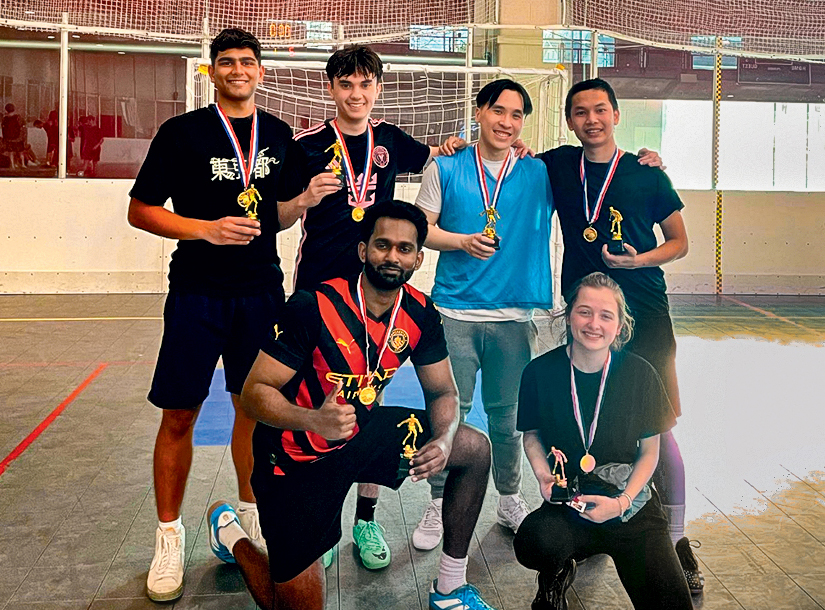
For the past several years, the International Students Association has organized its own “World Cup” inside Kirby’s indoor soccer courts. Held during ISA Extravaganza Week in late March, the soccer tournament is made up of teams organized by the global regions with which students identify. Last year, more than 50 players formed eight teams, representing approximately 25 countries from North America, South America, Africa, Asia, the Middle East, and Europe. “This event is meaningful because soccer, or football, is one of the single greatest unifying things we have seen in human history,” says Paolo Garcia ’27, president of ISA. Garcia, who is half-Filipino, competes for Team Asia—the group that won the tournament last year (pictured, below). “It is the most popular sport in the world, and despite our individual cultural differences, it gives our diverse Lafayette community the chance to unite over our shared love for the sport, whether you’re there to play or cheer your team on.”
Those players include Lionel Messi, maybe the best to ever play the game, but also Thomas Müller of Germany, Sergio Busquets of Spain, and French goalkeeper Hugo Lloris, all World Cup winners with their home countries. “Messi and others are opening the door for players to come over, and because the level of play has risen so much, MLS now gives players the opportunity to play in one of the top leagues in the world,” Pursel says. “The style and quality of our game is direct and physical. Players are fast and athletic, and our league has close to the most goals per game. That’s the kind of play we want to see.”
Kelly Fitzgerald Lorenzo ’07 says another huge draw of MLS is the in-stadium experience. Lorenzo is senior director of media commercial operations and started with MLS soon after graduating from Lafayette. “It’s
one of the best sports experiences, for sure,” she says. “All the clubs work really hard to engage the local culture; there are all kinds of tifos [large banners unfurled in the stands] and fan rituals at games.”
That fan experience is magnetic, Pursel says. “We have 25 soccer-specific stadiums. They’re beautiful buildings and have great atmospheres. We know that if people come to the game, even if they aren’t huge soccer fans, they will want to come back and spread the word.”
MLS is gaining popularity with international audiences as well, in part because of stars the league has been able to attract. “A lot of the international interest is player-driven,” Lorenzo says. “When Son Heung-Min, the former star for Tottenham Hotspur, joined Los Angeles Football Club, we saw explosive growth in our viewership and social media engagement in Korea. We saw the same thing in Germany when Thomas Müller signed with Vancouver.”
And now, the upcoming World Cup offers a massive opportunity for those who love the game and are working to develop it in the U.S. to break through to another level of visibility and popularity. With more than 100 games, the 2026 tournament, kicking off June 11 and finishing with the championship final July 19 in East Rutherford, N.J.—less than 90 minutes from Lafayette’s campus—is set to be the biggest in history.
World Cup match atmospheres are unparalleled, in part because of the international pageantry, but also because the chance to play on the global stage is so precious. In the four years between every World Cup, at least 200 national teams play grueling continental qualifying tourneys that can last two years or more, and upsets are frequent. After more than two decades of success, the U.S. men missed out on the 2018 World Cup, and even perennial powers like Italy and the Netherlands have failed to qualify for recent World Cups. The 2026 edition will feature four nations that have never before played in the World Cup.
Like any major sport, soccer has a complex history. Abraham Tapiwa Seda, assistant professor of history, understands this and developed a popular course called The Beautiful Game: A Global History of Soccer. In it, Seda covers the origins of the game, as well as the political and economic aspects of the sport. “People assume soccer originated in England, but there’s a hidden history of our ancient ancestors playing games very similar to modern-day soccer,” Seda says.
“In January, a headline in The Economist blared, “America is now the biggest market for international football.”
What the Football Association in England did in the 19th century, says Seda, was formalize the game. The British also successfully transported their version of the game to the colonial world in a way that has left a lasting legacy. “These colonial spaces in turn aren’t just passive recipients of the game; they experiment with it in ways that transform the game. There’s an economic component as well. Many of my favorite players, who are Brazilian, grew up in the favelas, and soccer was a chance to make something of their lives. You play differently under those conditions.”
With World Cup matches being played in five MLS stadiums, and 15 venues being used for training by national teams, Lorenzo and Pursel have been working to create maximum synergy with the World Cup to engage current fans and win over new ones. “We’re going to have watch parties and different opportunities for MLS fans to come out,” Lorenzo says. “And while we always see a huge increase in soccer interest after a World Cup, there’s also a dip, so how do we avoid that and keep momentum going and people interested?”
Part of the World Cup spectacle is the unveiling of the uniforms, which often have imagery or references of unique significance to each nation. Matt Lancor ’88, vice president of sales for lifestyle at PUMA, is a leader at his company in preparing for the big event. (The brand already sponsors some of the best players in the world: Neymar Jr., plus U.S. stars Christian Pulisic and Weston McKennie, to name a few.)
PUMA will be sponsoring uniforms—or “kits” in soccer parlance—for 10 teams competing in this World Cup, meaning about 20% of the total teams in the event will be in their apparel. “This summer, if there’s a World Cup game on the television, there’s a good chance it will be a PUMA team,” Lancor says. “It’s going to be powerful.”
It’s no surprise to find such a large contingent of Lafayette grads and former players working at the highest level of soccer. The sport has a storied history at the College. “If you look at a lot of our signs and uniforms, they say ‘Established 1913.’ Our team is older than some Premier League teams,” says Dennis Bohn, coach of Lafayette’s men’s soccer team for the past 25 seasons. “An Irish immigrant living in Easton started the team. He was dribbling a ball on the Quad, some kids saw him, jumped in, and later convinced the administration to form a soccer team.” The Irishman, David Paul, was the first coach. In the century-plus that followed, Lafayette’s program—like the United States’—has enjoyed continued growth.
Groff, Lancor, Lorenzo, and Pursel all played a full four years on Lafayette varsity squads. Tom Neale ’92 won an MLS Cup Championship as general manager of the San Jose Earthquakes. More recently, Griffin Huff ’25 and Alex Sutton ’22 both played professionally in the MLS Next Pro league, with Huff currently under contract with the Chattanooga Football Club.
In September, Bohn eclipsed 200 career wins at Lafayette and would lead the Leopards to one of the program’s greatest seasons ever, capturing the Patriot League title on Lehigh’s home turf in a thrilling finish that went to a penalty shootout. The win would advance the team to the first round of the NCAA Tournament. “As coach, we’ve won five championships, and I love them all, but this one was a special moment in the program’s history and my career.”
For all of this excitement on the pitch, from the Patriot League to the pros, a question lingers for sports communities across the country: Will the United States ever become a true soccer nation?
According to Groff, we already have. “In 1990, we had two sponsors, Budweiser and Adidas, and now we have 60. We draw 11,000 fans for an amateur match in Annapolis,” he says. “We’ve got 3 million registered youth players and 300,000 adults. We have both highlevel professional teams and 2,000 elite amateur teams. We’re not at the level of the NFL, but we are, as they say in Europe, a football country.”