Nesting at Metzgar
At the center of research conducted at Metzgar are common songbirds in North America that have learned to adapt their habitats to live alongside humans.
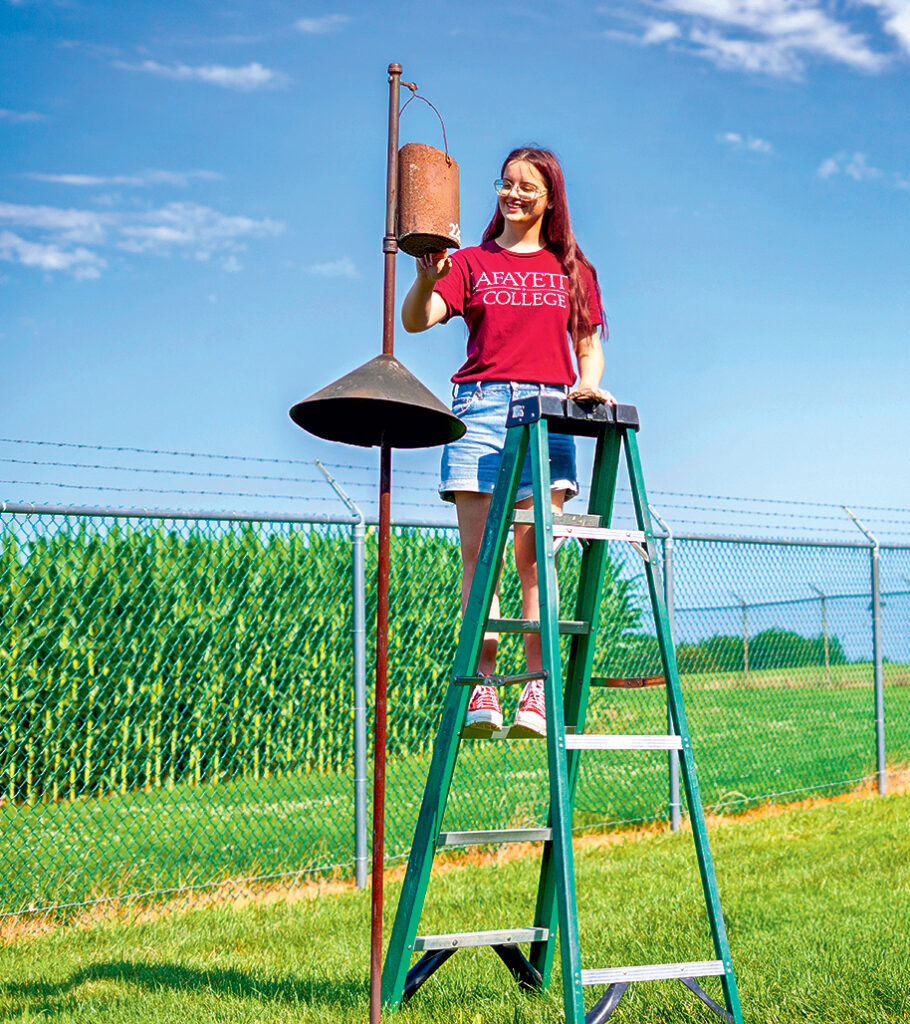
Rebecca Capone ’26 checks a nest box for breeding activity.
Photos by JaQuan Alston
Metzgar Fields Athletic Complex has many purposes, but for Biology Department head Mike Butler and his students, it’s used for field research to tend to house sparrows.
“We’re out there Saturdays, Sundays, all of the time,” says Butler, an organismal biologist. “We just pay attention, and we go when the birds go.”
Butler’s research students, Melania Brown ’28, Rebecca Capone ’26, Sean Drahouzal ’26, Bianca Hall ’27, and Kendrick McWilliams ’28, spent last summer taking shifts to refill eight vertical flats, each lined with colorful faux bird feathers and rectangular pieces of plastic. The structures are spaced throughout the property with laser precision, thanks to the collaboration with Civil and Environmental Engineering Department head Mike McGuire.
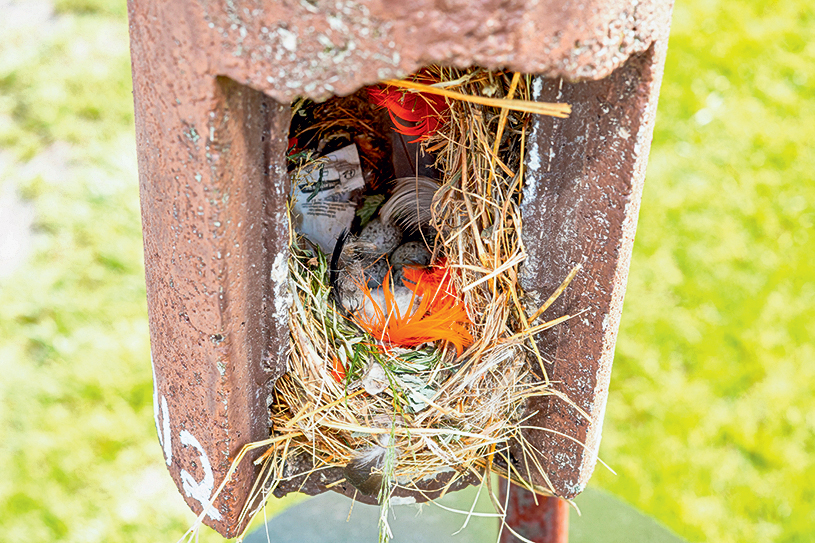
Through this project, house sparrows were offered different options for nest materials. “Spoiler alert—they choose feathers,” Butler says. “We had to replace all the feathers almost every time.”
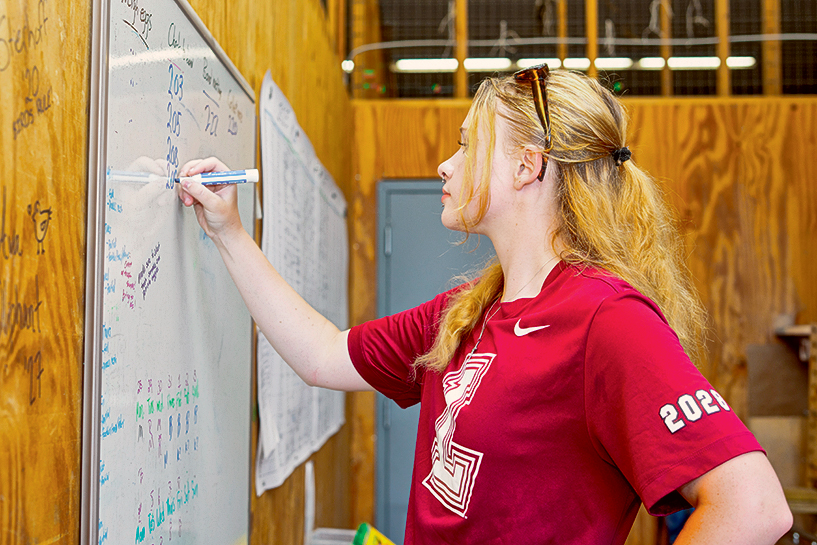
Students also recorded the biological data from hundreds of sparrows populating the 83 nest boxes in the area. They checked boxes, weighed eggs, measured and banded nestlings, collected blood samples, and more. Brown’s favorite responsibility was banding, fitting each nestling with a small electronic bracelet for tracking. “This gave me an opportunity to explore fieldwork,” Brown, a biology major, says. “Just learning how to handle a living, breathing bird and get it to do what you need to do was definitely difficult.”
Brown also learned about the importance of data accuracy and integrity. Having a big group of students—the largest Butler has ever had at Lafayette—was beneficial. “Sometimes it’s easy for stuff to get missed, but with five pairs of eyes, someone is bound to catch it,” Capone says. “So that’s very helpful to make sure we’re all keeping each other accountable.”
“It would be impossible for me to do this alone,” Butler says. “I depend upon teamwork and collaboration.”
These birds at Metzgar are the focus of Butler’s ongoing research to investigate how and why house sparrows select nest materials—and, perhaps, the positive consequences for their offspring in the nests. “Feathers actually seem to be helpful in terms of [improving] the number of [surviving] fledglings and growth rates, but they still put trash in the nests anyway,” Butler says. “So, are they putting trash in there because they like it or because they don’t differentiate between the two?”
After the birds fledged, students dissected every nest to separate out feathers, trash, and the rest of the materials: shirt labels, Powerbar wrappers, dog hair. Butler says this trash doesn’t seem to be good for house sparrows. As of early spring semester, students are still collecting data, and will continue to meticulously dissect the 180 nests from the year before. Meanwhile, the vertical flats will likely be retired in favor of carefully placed nesting materials in the grass, allowing for greater accessibility.
The student team is also pursuing an independent research project of its own: comparing the rate of nestling feeding by parents to nestling growth rates and outcomes. (There are cameras on-site for observations.) Butler is happy his students will learn even more about experimental design, dataset construction, and thinking through what information they need.
In February, Butler began his first awarded National Science Foundation grant to continue his research with birds, adding fake “spy eggs” to the picture.
In collaboration with former engineering professor Jon Wallace, Butler is creating a model for a 3D-printed house sparrow egg—no bigger than a thumbnail, or about 2.2-by-1.5 centimeters—stuffed with a thermal sensor, rechargeable wireless battery, computer board, and bluetooth communication. “It’ll measure the temperature inside the nest without getting removed by the parents,” he says. A problem many bird biologists
encounter, Butler explains, is their subjects’ response to unwelcome additions to their nest. These new model eggs not only limit interference, but also reduce complex technological infrastructure and cost. Scientists have tried faux eggs before, just not at this size.
The eggs will allow Butler to compare nest temperature to the number of eggs and pieces of trash present in the nest, then examine how that impacts nesting development. This stems from the research of Jenny Minnick ’17 and Brooke Weiss ’24, who examined 3D-printed eggs and trash in nests for their honors theses, respectively. While the name for the eggs is still in the works, Butler knows the potential: “The goal is to maybe patent it, then give it away so other researchers can use this technology.”